
Beyond the Sideline: How Women in Athletic Training Transformed Sports

Written by Linda Herron
Women Sports USA®
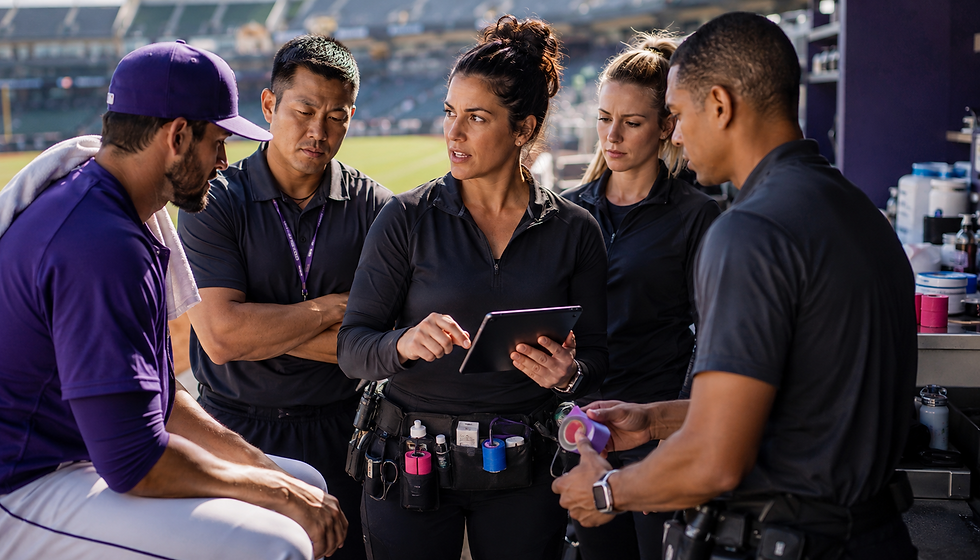
When an athlete goes down, the crowd sees the moment. They see the collision, the awkward landing, or the sudden pause in play. What they may not see is the woman already moving toward the athlete—prepared to assess the injury, provide immediate care, and help determine what comes next.
Behind many of these critical moments are women in athletic training whose expertise has helped transform athlete care and sports medicine.
Athletic trainers work beyond the sideline, inside training rooms, rehabilitation centers, clinics, and sports medicine departments. They help prevent injuries, respond during emergencies, guide rehabilitation, and advocate for an athlete’s long-term health.
Today, women are a powerful presence in athletic training. Their place in the profession, however, was not simply given to them. It was built by pioneers who entered spaces where women were rarely welcomed, earned the trust of athletes and coaches, and demonstrated that knowledge and leadership are not defined by gender.
Their work helped transform athletic training—and the way athletes are cared for.
More Than Tape, Ice and the Sideline
Athletic training is sometimes misunderstood as personal training or strength coaching. Although these professions may work together, their responsibilities are different.
Athletic trainers are health care professionals who collaborate with physicians and other specialists to prevent, assess, and manage injuries and medical conditions. Their work can include emergency response, injury evaluation, rehabilitation, return-to-play planning, and education. Their work also reflects the remarkable evolution of women’s sports training, from limited early resources to today’s evidence-based systems of prevention, treatment and recovery.
They may be the first person to recognize a concussion, respond to a cardiac emergency, or notice that an athlete’s recurring pain requires additional medical attention. They are also often the professionals athletes see every day throughout recovery.
That daily presence matters.
An athletic trainer learns how an athlete moves, communicates, and responds under pressure. She may recognize when something is wrong before the athlete is ready to admit it. She must understand the desire to compete while remaining willing to make a decision that protects the athlete.
The best athletic trainers do more than treat injuries. They build trust.
How Women in Athletic Training Created Their Own Opportunities
Throughout much of the history of organized sports, athletic training facilities and professional sports staffs were predominantly male. Women often faced restricted access to education, mentorship, team roles, and leadership opportunities.
As opportunities for female athletes increased, the growth of medical and performance staff supporting them didn't always keep up. Female athletic trainers often had to work in separate facilities, receive fewer resources, or demonstrate their ability to treat male athletes.
Their qualifications could be questioned before their work was ever observed.
Those barriers did not stop women from entering the profession. Instead, they created programs, mentored students, contributed to research, and demonstrated their ability in high-pressure competitive environments.

The progress made by women in athletic training has strengthened sports medicine and created safer, more supportive environments for athletes at every level.
With every athlete they treated and every leadership position they earned, they widened the path for those who would follow.
Gail Weldon Opened Doors at the Highest Levels
Gail Weldon was one of the women who changed what was possible.
She was the second woman to join the National Athletic Trainers’ Association and one of the first 10 women certified as athletic trainers. She later became the first female athletic trainer hired by the United States Olympic Committee.
Weldon was selected for the 1980 Olympic Sports Medicine Staff and served as director of athletic training and physical therapy for the 1984 Olympic Games in Los Angeles. She was also the head women’s athletic trainer at UCLA and founded Women’s TRACC—the Training Room and Conditioning Center.

Her influence extended beyond the athletes she treated. Her achievements belong to the larger history of women breaking barriers in the Olympic movement, where every breakthrough created new possibilities for future generations. Weldon was an educator, author, business owner, and mentor who helped other women see that they belonged in athletic training.
At a time when women had few visible examples in sports medicine leadership, she became one.
Today, the National Athletic Trainers’ Association presents the Gail Weldon Award of Excellence to recognize significant contributions to mentoring women in athletic training or improving health care for female athletes. Her legacy continues through every recipient and every woman encouraged to move forward because someone believed in her potential. (National Athletic Trainers’ Association)
Ariko Iso Broke an NFL Barrier
Professional football has long represented one of the most difficult environments for women seeking careers in athletic training. Its culture, traditions, and leadership structures left few openings for women—particularly on full-time medical staffs.
Ariko Iso helped change that.
In 2002, the Pittsburgh Steelers hired Iso as the NFL’s first female full-time athletic trainer. Her appointment was historic, but her success was grounded in preparation, skill, and professionalism.
Working in the NFL requires far more than treating injuries on game day. Athletic trainers manage demanding schedules, rehabilitation plans, medical records, emergency preparation, and constant communication with players, physicians, and coaches. They work in an environment where competitive pressure is intense, and health decisions can affect careers.
Iso demonstrated that a woman could succeed in that environment while meeting the highest professional expectations. Her presence also allowed young women studying athletic training to imagine themselves working in football—not as an exception, but as a qualified member of the sports medicine team. (NFL)
Sue Falsone Made Major Professional Sports History
Another important breakthrough came when Sue Falsone became the head athletic trainer and physical therapist for the Los Angeles Dodgers.
When the Dodgers appointed her to the position, Falsone became the first woman to serve as head athletic trainer for a major American professional sports team.
That distinction carried significance far beyond baseball.
A head athletic trainer is responsible not only for clinical care but also for communication, coordination, and leadership. The role requires working with athletes, physicians, coaches, executives, and other performance professionals while making decisions under public and organizational pressure.
Falsone’s appointment placed a woman at the center of one of professional sports’ most important departments. It challenged the assumption that women could assist in athlete care but were not ready to lead it.
She proved that women belonged in the room where medical strategies were developed and decisions were made. (Major League Baseball)
Changing How Female Athletes Are Understood
The impact of women in athletic training is not limited to breaking employment barriers. Women have also helped expand the conversation around the health needs of female athletes.
For generations, sports science and medical research have often treated the male body as the standard. Female athletes were expected to train and recover within systems that did not always account for their physiology or health experiences.
Athletic trainers have helped bring greater attention to issues including menstrual health, bone health, nutrition, pregnancy, postpartum return to activity, and the relationship between fueling and athletic performance.
They have also helped challenge the idea that losing a menstrual cycle is simply a normal result of intense training. It can instead be an important warning sign that an athlete is not receiving enough energy to support both performance and basic physiological functions.
Because athletic trainers often interact with athletes daily, they may be especially well positioned to notice gradual changes. A pattern of fatigue, recurring injuries, altered mood, or declining performance can reveal more than a single medical evaluation.
Listening becomes part of prevention.

The Athletic Trainer as an Athlete Advocate
An athletic trainer often stands between an athlete’s desire to return and the reality of what her body needs.
That position requires courage.
A coach may be thinking about the next competition. An athlete may fear losing her role. A team may feel pressure to win. The athletic trainer must evaluate the situation through the lens of health and safety. That responsibility is closely connected to the coach’s role in sustainable performance, particularly when deciding whether an athlete needs encouragement, modification, or complete rest.
Sometimes leadership means helping an athlete return confidently. At other times, it means saying she is not ready.
Those decisions may not always be celebrated in the moment, but they can protect an athlete from a more serious injury or a longer recovery.
Athlete-centered care also means seeing the person beyond the diagnosis. An injured athlete may experience isolation, anxiety, or a loss of identity. She may worry that teammates are moving ahead without her or that coaches will view her differently.
A trusted athletic trainer can help her see that recovery is not a sign of weakness but an integral part of athletic growth. This athlete-focused strategy emphasizes why rest and recovery are crucial for enhanced performance.
Expanding Into Classrooms, Clinics and Communities
The women transforming athletic training are not found only in professional or collegiate sports.
They are working in high schools, youth programs, physician practices, rehabilitation clinics, performing arts organizations, public safety departments, and workplaces. They are teaching future athletic trainers, conducting research, and developing safety procedures that affect entire communities.
At the high school level, an athletic trainer may be responsible for athletes across numerous teams. She may prepare emergency action plans, educate coaches, communicate with families, and manage injuries among young people who are still learning how to understand their bodies.
Her presence can be lifesaving.
It can also influence how young athletes think about health. When athletes learn early that reporting symptoms is responsible—not disappointing—they are more likely to make safer decisions throughout their careers. Athletic trainers and coaches can work together to create environments focused on developing healthy athletes for life.
Progress Does Not Mean the Work Is Finished
Women have become increasingly visible throughout athletic training, but representation alone does not guarantee equality.
Leadership opportunities, compensation, professional respect, travel expectations, and work-life balance remain important concerns. Women may still face assumptions about whether they can work with men’s teams, manage certain sports or lead major medical departments.
Representation must therefore extend beyond entry-level positions. Women must also have opportunities to become head athletic trainers, directors of sports medicine, researchers, educators, and organizational leaders.
Progress should not be measured only by how many women enter the profession. It should also be measured by how many are supported, promoted, and empowered to shape its future.
A Legacy Built Beyond the Sideline
The history of women in athletic training is a story of expertise, persistence, and care.
Women such as Gail Weldon, Ariko Iso, and Sue Falsone opened highly visible doors. Countless others created change away from national attention—in school training rooms, college classrooms, rehabilitation clinics and community sports programs.
They did not simply join athletic training. They helped transform it.
They strengthened professional standards, expanded knowledge about female athletes, and demonstrated that compassionate care and decisive leadership belong together. Most importantly, they helped create sporting environments in which athlete health is valued alongside athletic achievement.
Their influence can be seen whenever an athlete feels safe reporting an injury, receives an individualized recovery plan, or returns to competition with confidence in her body.
The game may unfold in front of the crowd, but some of its most important work happens beyond the sideline.
That is where women athletic trainers have been changing sports—one athlete, one decision, and one opened door at a time.
At Women Sports USA®, we celebrate the women whose knowledge, courage, and care make sports safer and stronger. Their contributions remind us that every role matters, every barrier broken creates opportunity, and every story deserves to be remembered.
Dream. Believe. Achieve.

Linda Herron is the Founder of Women Sports USA®, a former Division I field hockey athlete, coach, author, and longtime advocate for preserving women’s sports history. Through storytelling, she celebrates the athletes, coaches, officials, and trailblazers who helped change the game.


Comments