
From Exclusion to the Starting Line: How Women Broke Barriers in the Early Olympics

Written by Linda Herron
Women Sports USA®
The Olympic Games are celebrated as the world’s greatest stage for athletic achievement. Yet when the modern Olympics began in Athens in 1896, women were not invited to compete.
The absence was intentional. Many sports leaders of the time believed athletic competition belonged exclusively to men. Women were considered too physically fragile for demanding events, and their participation was often described as inappropriate or unfeminine.
But women refused to accept that the Olympic movement could represent the world while leaving them on the sidelines.
From the first female competitors in Paris in 1900 to the long-awaited introduction of women’s track and field in Amsterdam in 1928, early Olympic athletes repeatedly challenged the limits placed upon them. They competed in restrictive clothing, received little recognition, and faced rules created without their voices.
They still made history.
Their victories were about more than medals. Each appearance, record, and finish helped prove that women belonged on the world’s biggest sporting stage.
Women Were Excluded From the First Modern Olympics
When the modern Olympic Games opened in Athens in 1896, every competitor was a man.
Women were not simply overlooked. The Olympic movement had been developed around nineteenth-century ideas about masculinity, physical strength, and the role sports should play in preparing men for public and military life.
Athletic competition was considered beneficial for men but potentially harmful to women. Female athletes were discouraged by social expectations, limited access to training, and warnings that strenuous exercise could threaten their health.
Women were expected to watch—not participate.
Despite those restrictions, one woman demonstrated that female athletes could not be kept entirely outside the Olympic story—one of many key milestones in women’s sports history.
Stamata Revithi, a Greek woman, reportedly completed the marathon course one day after the official men’s race. She was not permitted to enter the Olympic event or finish inside the stadium, but her determination became an early symbol of women’s refusal to remain spectators.
Revithi did not receive a medal or official recognition. Her run still carried a powerful message: women were ready to compete, even if Olympic leaders were not ready to accept them.
The First Women Enter the Olympics in 1900
Four years later, women were permitted to participate when the Olympic Games were held in Paris.
According to the International Olympic Committee’s history of women’s Olympic participation. According to the International Olympic Committee, women appeared in five sports: tennis, sailing, croquet, equestrianism, and golf.
Their opportunities were narrow and largely limited to activities considered socially acceptable for women. Events requiring sustained running, throwing, physical contact, or visible exertion remained closed to them.
Still, the barrier had been broken.
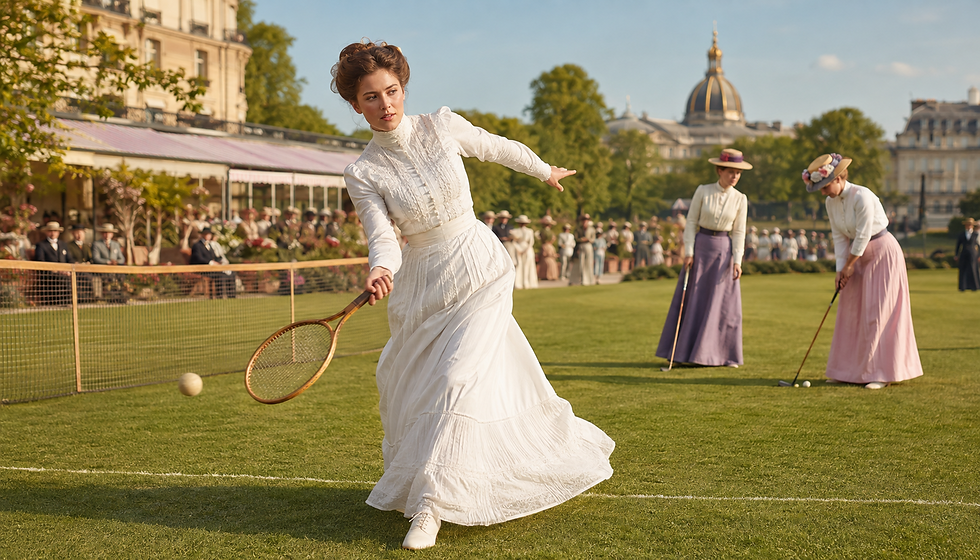
Women were no longer entirely outside the Olympic Games. They were now competitors—and some became champions.
Hélène de Pourtalès Makes Olympic History
Hélène de Pourtalès competed in sailing as a member of a Swiss team alongside her husband, Hermann, and nephew, Bernard.
Their team won the first race in the one-to-two-ton sailing class, making de Pourtalès the first woman recognized as an Olympic champion. She also earned a silver medal in another race.
Her achievement was historic, although women’s accomplishments at the loosely organized 1900 Games did not receive the attention or celebration they deserved.
Charlotte Cooper Becomes the First Female Individual Champion
British tennis star Charlotte Cooper entered the Paris Games as an accomplished Wimbledon champion and became one of the historic first female Olympic champions.
Cooper won the women’s singles competition, becoming the first woman to earn an individual Olympic championship. She also won the mixed doubles event with Reginald Doherty.
Her victory offered undeniable evidence that women could perform with skill, composure, and competitive excellence on an international stage.
Cooper was not merely participating. She was winning.
Margaret Abbott Wins Without Knowing It
American golfer Margaret Abbott also made history in Paris.
Abbott won the women’s golf competition with a nine-hole score of 47, becoming the first American woman to win an Olympic event. However, the 1900 competitions were held as part of the Paris Exposition and were not organized or promoted in the same way as today’s Olympics.
Abbott reportedly believed she had entered an ordinary golf tournament and died without realizing that history would recognize her as an Olympic champion.
Her mother, Mary Abbott, competed in the same event, making them the first known mother and daughter to participate in the same Olympic competition.
Their story reveals both the progress and the limitations of the moment. Women were making Olympic history, but their achievements were not always documented, publicized, or fully understood—even by the athletes themselves.
Progress Came One Event at a Time
Women’s participation did not expand quickly after 1900.
Olympic leaders continued to decide which sports were appropriate for women, often favoring events viewed as graceful or traditionally feminine. The question was not whether women possessed athletic ability. It was whether male-controlled institutions were willing to recognize it.
Women competed in archery at the 1904 Games, while figure skating appeared at the 1908 Summer Olympics. Tennis and other accepted sports provided some opportunities, but the Olympic program remained overwhelmingly male.
A significant breakthrough came at the 1912 Stockholm Games when women were permitted to compete in Olympic swimming.
Australian swimmer Fanny Durack won the 100-meter freestyle, becoming the first woman to earn an Olympic swimming championship. Her success challenged persistent claims that vigorous exercise and endurance competition were unsuitable for women.

Women were gradually gaining access, but each opportunity came with restrictions.
In some countries, athletes faced opposition simply for wearing competitive swimwear. They had fewer places to train, limited financial support, and little influence over the organizations governing their sports.
Every woman who reached the Olympics had already overcome barriers long before arriving at the competition.
Antwerp 1920 Created New Olympic Heroines
Following the cancellation of the 1916 Olympics because of World War I, the Games returned in Antwerp in 1920.
Women were still offered only a small number of competitive opportunities, but their presence was becoming increasingly difficult to dismiss.
French tennis champion Suzanne Lenglen delivered one of the defining performances of the Games, making the 1920 Olympic women’s singles tennis tournament an important chapter in women’s sports history.
Lenglen’s athleticism, confidence, and distinctive playing style attracted international attention. She became one of the first globally recognized female sports stars and helped establish women’s tennis as a major spectator sport.
Her success also demonstrated something larger: when women were given access to elite competition, audiences wanted to watch them.
The women competing in Antwerp were not asking whether they belonged. Their performances were answering the question.
Alice Milliat Challenged the Olympic Establishment
While athletes were breaking barriers in competition, Alice Milliat was confronting the institutions that continued to limit them.
Milliat was a French athlete, rower, and sports administrator who believed women deserved access to a complete range of sports—especially track and field.
Women were running, jumping, and throwing competitively, but Olympic officials continued to exclude them from athletics. Milliat understood that waiting quietly for change would not be enough.

She became a leader of the Fédération Sportive Féminine Internationale, an organization that promoted international athletic competition for women. In 1922, she helped organize a major women’s international competition in Paris that became associated with the Women’s World Games movement.
These competitions allowed women to participate in events they were denied at the Olympics. Athletes raced, jumped, and threw before large crowds, demonstrating that women’s track and field was competitive, compelling, and deserving of international recognition.
The Women’s World Games created pressure that the Olympic movement could no longer ignore.
Milliat and the athletes she represented did not wait for permission to prove themselves. They built their own stage—and forced established sports organizations to pay attention.
Women Finally Enter Olympic Track and Field in 1928
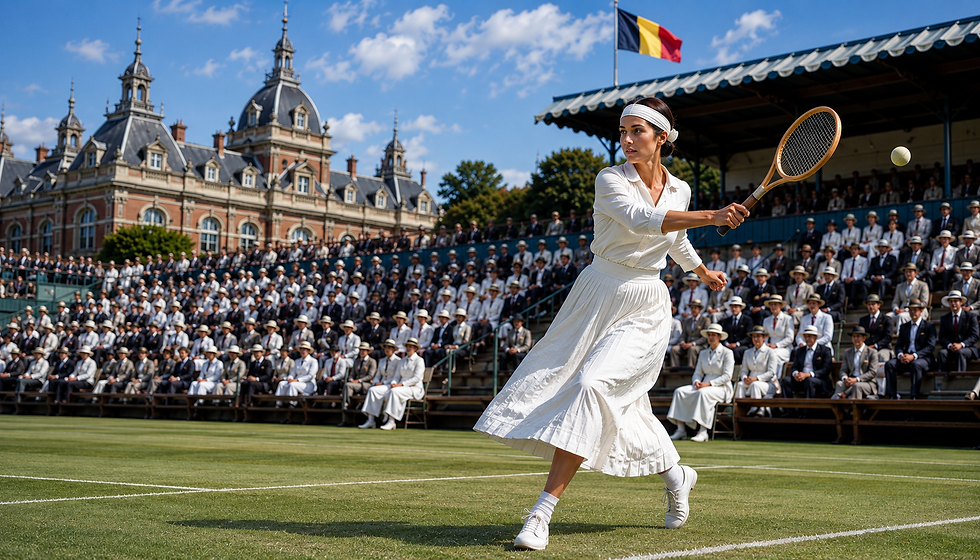
At the Amsterdam Olympics in 1928, women were finally allowed to compete in Olympic track and field.
The program remained limited to five events:
100 meters
800 meters
4×100-meter relay
High jump
Discus throw
Women also competed in Olympic gymnastics for the first time.
These opportunities were a major victory, but they came more than three decades after the first modern Olympics and only after years of organized pressure from female athletes and advocates.
The women competing in Amsterdam knew their performances would be judged as evidence—not simply of their individual abilities, but of whether women as a group were supposedly capable of competing.
That was an unfair burden no male athlete was asked to carry.
The 1928 Women’s 800-Meter Controversy
The women’s 800-meter final became one of the most consequential events in early Olympic history.
Germany’s Lina Radke won the race in world-record time, becoming the first women’s Olympic 800-meter champion. Japan’s Kinue Hitomi earned silver, and Sweden’s Inga Gentzel took bronze.

Rather than concentrating on their exceptional performances, some reports claimed that multiple competitors had collapsed from exhaustion after the race. The coverage reinforced existing beliefs that women were too physically fragile for distance running.
Historical examinations tell a different story. World Athletics’ account of the 1928 women’s 800 meters reports that only one runner fell after finishing—not the field of physically overwhelmed women described in sensational accounts.
Nevertheless, the narrative had lasting consequences.
The women’s 800 meters was removed from the Olympic program and did not return until 1960. For 32 years, women were denied the opportunity to compete in the event at the Olympics. Similar assumptions continued limiting women’s distance-running opportunities for decades, delaying the first Olympic women’s marathon until 1984.
The controversy demonstrated how easily stereotypes could be used against female athletes. A demanding race was treated as proof that women could not handle endurance competition, even though exhausted male runners were never used to justify eliminating men’s events.
The athletes had proven they could race. The system chose to protect an outdated belief instead.
Women in the Early Olympics Competed for More Than Medals
The women who entered the early Olympic Games did not receive the opportunities modern athletes experience.
They competed without equality, adequate representation, or control over the rules governing their participation. Many received limited media coverage, and some did not receive full recognition until years later.
Yet their influence extended far beyond their results.
Every time a woman stepped onto an Olympic court, entered a pool, boarded a racing boat, or took her place at a starting line, she expanded what the next generation could imagine.
Hélène de Pourtalès showed that a woman could become an Olympic champion.
Charlotte Cooper proved that a woman could win an individual Olympic title.
Margaret Abbott became part of American Olympic history, even without knowing it.
Fanny Durack demonstrated women’s strength and speed in the pool.
Suzanne Lenglen became an international sports star.
Alice Milliat proved that women could organize, lead, and create powerful competitions of their own.
Lina Radke, Kinue Hitomi, and the women of the 1928 track program showed that female athletes belonged in Olympic athletics—even when the response to their achievements remained shaped by prejudice.
The Starting Line Was Only the Beginning
Women’s entrance into the Olympics was not a gift handed down by sports leaders. It was the result of athletes and advocates who persisted when the rules, institutions, and social expectations were stacked against them.
Progress was not immediate or uninterrupted.
One barrier would fall while another remained. An event would be added and later removed. A record-breaking performance could be overshadowed by a misleading headline. Women were allowed to compete while still being denied leadership, recognition, and equal opportunity.
But they kept moving forward.
The early Olympic women changed more than the program of the Games. They challenged the world’s understanding of strength, competition, and who had the right to be called an athlete.
Today’s Olympians compete on a stage built in part by women whose names were often missing from the headlines. Remembering them is not simply about looking back. It is about understanding that every starting line available to women today was reached because someone before them refused to remain on the sidelines.
Their races ended long ago.
Their impact is still moving forward.
At Women Sports USA®, we believe every story matters. By preserving the stories of the women who challenged restrictions and opened doors, we honor the past while empowering the athletes creating history today.
Continue exploring the athletes, advocates and defining moments that changed sports in the Women Sports USA® History Hub.
Dream. Believe. Achieve.
Women Sports USA®
Honoring the Past. Empowering the Future.

Linda Herron is the Founder of Women Sports USA®, a former Division I field hockey athlete, coach, author, and longtime advocate for preserving women’s sports history. Through storytelling, she celebrates the athletes, coaches, officials, and trailblazers who helped change the game.


Comments