
Maginur Gilmutdinova: Building Confidence Through Aesthetic Group Gymnastics

From Team Sakura’s first international gold to its move into senior competition, Maginur’s coaching shows how trust, responsibility, and shared challenge can shape athletes beyond the score.
Written by Linda Herron
Women Sports USA®
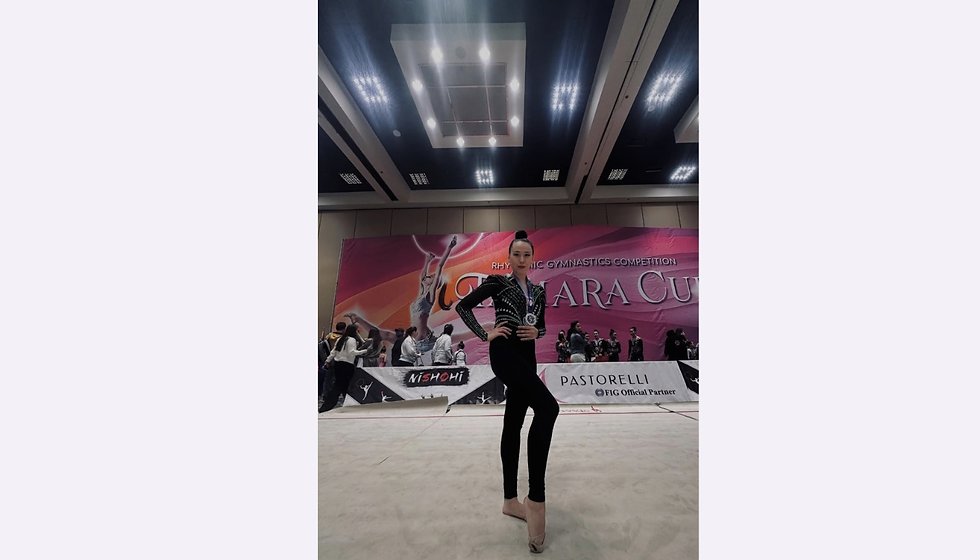
Before Team Sakura won junior gold in Hong Kong in October 2024, coach Maginur Gilmutdinova saw something many coaches recognize: talented athletes wondering whether they belonged. It was their first international competition, and standing among teams from other countries made the opportunity feel bigger than it did in training. Maginur remembered their nervous expressions and the question that seemed to come with them: Were they ready?
The team arrived early to adjust to the time difference and climate. The club’s founder, who had supported Maginur throughout her journey—including at international competitions—was there by her side. Together, they helped the athletes settle in, using conversation and activities to ease the pressure. After the first day of competition, something shifted: the athletes advanced to the finals and learned they were among the leading teams. By the next day, they had taken greater ownership of their preparation, showing an independence and determination that surprised even Maginur.
Winning gold at the 2024 Hong Kong Cup was an achievement worth celebrating. What stayed with Maginur, however, was watching those young athletes begin to believe in themselves. That shift from uncertainty to ownership became a theme in our conversation. She returned to children growing more confident, teams learning to work together, and athletes choosing difficult challenges—all of which reveal the coach she strives to be and the influence she hopes to have.

Maginur Gilmutdinova's Coaching Journey Across Countries and Cultures
Gymnastics has been integral to Maginur’s life for as long as she can recall. She has competed with the Russian national team in aesthetic group gymnastics and coached in Russia, Greece, Egypt, and Turkey before moving to the United States. Each country exposed her to different expectations, communication styles, and ways of receiving instruction. Over the years, she realized that understanding both the sport and the athlete must go hand in hand.
Maginur stated that she has learned to adjust her communication without compromising her standards. She still expects effort, commitment, and a willingness to learn, but she recognizes that not all athletes receive the message in the same way. Families bring their own experiences to sports, and children need various kinds of support as they develop. Effective coaching requires noticing those differences and finding ways to connect.
Our conversation made it clear how much Maginur enjoys helping children become more capable, both in their sport and in their lives. She looks beyond how an athlete performs on a given day, focusing on helping that young person take responsibility, face challenges, and keep learning.
Learning to Move—and Work—as One
For readers discovering aesthetic group gymnastics, or AGG, Maginur offered a helpful comparison: synchronized swimming performed on a carpet. The sport combines coordinated movement, music, and expression, with athletes working together to create a single, cohesive performance. Each gymnast must understand her own role while remaining connected to the group's movement.
Maginur explained that even eight talented athletes do not automatically become a successful team. They must learn to feel the timing together, support one another, and make their individual skills part of something shared. That connection takes practice. A strong performance depends on how well the athletes understand one another and how consistently they contribute to the group.
As a former athlete, I understood what she meant. Talent creates possibilities, but teammates still must learn to trust one another and work toward the same goal. In AGG, the audience can see that relationship through the movement. Behind it are hours spent learning to work as a team.
Building Opportunity and Earning Trust
Maginur began developing AGG in the United States with a clear goal: to give young gymnasts more opportunities to compete internationally. She contacted the federation and reconnected with coaches in Russia to refresh her knowledge after time away from competition. The endeavor relied on her experience but also required her to become a student of the sport once more.
The program began with two teams, but expanding into an unfamiliar sport required earning families’ trust. Some parents initially questioned what AGG could offer their children. Strong performances at national competitions opened the door to international opportunities, and as the athletes gained experience and achieved success abroad, families began to see the possibilities. Parents who had once been uncertain started asking about forming additional teams.
For two consecutive years, Sakura represented the United States as a national team. In 2024, the team made history at the Hong Kong competition, earning the first U.S. gold medal at that level of international AGG competition.
By September 2026, the PNW Rhythmic & Aesthetic Group Gymnastics program had expanded to eight teams, with more in development. Maginur was proud of that growth, particularly the trust behind it. Families joined the program because they could see their children being challenged and making progress. Each new team gave another group of athletes access to the sport and the experience of building something together. As the program grew, helping athletes understand their responsibility to one another became even more important.
Responsibility Begins with Every Athlete
Maginur teaches that every athlete shapes what happens on the carpet. She works with gymnasts across a wide age range, adjusting her language and expectations as they develop while keeping the principle consistent: preparation, attention, and performance affect the teammates beside them and the team’s overall result.
Learning that responsibility involves more than practicing a routine. Young athletes also learn to manage emotions, communicate with teammates, and work through disagreements. Maginur spoke openly about the interpersonal challenges that can arise, especially during adolescence. She makes time to talk with athletes and listen to their concerns, involving parents when a larger problem requires attention.
These conversations help build a team that can function under pressure. Children need guidance as they learn how their choices affect others, along with opportunities to be heard. Over time, Maginur sees athletes becoming more aware of their responsibilities and better able to manage the relationships that come with being part of a team. Team Sakura’s 2024 season put that shared responsibility to the test.
Seeing Progress Beyond the Placement
The confidence Team Sakura gained in Hong Kong continued to shape its development. About a month after winning gold, the team competed in Estonia after about three weeks of training. Maginur couldn't travel because she hadn't obtained a visa, but their performance still showed a clear change: stronger connection, greater power, and a deeper ability to express the music through movement.
The team placed third in Estonia after earning gold in Hong Kong, yet Maginur saw meaningful improvement. The athletes looked more confident and mature, performing with a stronger sense of their team identity. Their placement told one part of the story; their development told another.
That perspective matters in youth sports because progress does not always show up in placement. Athletes can improve while facing stronger competition or finishing in a different position than they hoped. By recognizing changes in confidence, connection, and performance, coaches can help young people better understand their growth and build confidence that reaches beyond the scoreboard.
Choosing the Challenge with Team Sakura
After competing as juniors in 2024, Team Sakura faced a new decision in 2025: whether to move into the senior category and how much the athletes wanted to challenge themselves. Maginur described a demanding international field that would require more than stronger performances. Each gymnast would also need greater independence, maturity, and ownership of the team’s direction.
She wanted the athletes to have a voice in that decision. The coaches could explain what senior competition would require, but the gymnasts needed to understand and take ownership of the direction they chose. They chose to move forward. Their decision mattered to Maginur because it showed they were willing to accept greater responsibility for the team they wanted to become.
That season also brought Maginur an unexpected responsibility. When an injured athlete couldn't compete, she stepped in for the team and prepared to compete alongside the gymnasts she coached. During an already important transition, she had to support the athletes’ development while preparing under the same pressure they faced.

Giving Mistakes a Purpose
Working in both individual rhythmic gymnastics and AGG has helped Maginur see how differently athletes experience pressure. Some appeared more comfortable performing with a team at a major international event than competing alone at a smaller competition. Seeing how much the group’s support mattered led her to think more closely about how she prepared athletes emotionally.
The athletes work hard to prepare for competition, but Maginur also teaches them to use each performance as a source of information.
Any competition is still a practice.
— Maginur Gilmutdinova
After practices and competitions, they write down their mistakes, identify what needs attention, and return to training with specific things to address.
That review gives athletes a practical next step. Instead of fearing a mistake, they can examine it and focus on what to improve. Maginur reminds them that development is ongoing: as they become more capable, new challenges will appear, and they will keep learning how to respond.
Caring About the Person Beyond the Sport
When I asked about her coaching priorities, Maginur began by talking about who athletes are becoming beyond the sport. She connected that concern to the way she approaches their physical development. Gymnastics asks a great deal of the body, so she continues to study and learn with other coaches as they consider how to develop flexibility and skills responsibly.
Her thinking reaches years beyond the next competition. Maginur considers how athletes may feel after leaving gymnastics and wants their training to support a healthy future. The child preparing for a routine today will carry the physical and personal effects of that experience into adulthood, a responsibility she keeps in view as she coaches.
Maginur carries that same concern into the way she thinks about athletes’ lives beyond gymnastics. She expressed pride in athletes who have continued their education at universities including Harvard, Stanford, UCLA, and UC San Diego. She believes gymnastics helped them develop discipline, responsibility, and teamwork—qualities they carried with them as they pursued those opportunities. Watching them begin new chapters gives her another way to appreciate how far they have come beyond the gym.
What Japan Could Offer
When we spoke in September 2026, Maginur was preparing to bring four teams to competitions in Japan. She was especially excited about what the younger gymnasts would see: experienced international teams, a large audience, and athletes from other countries approaching the sport in diverse ways. She hoped those experiences would help them imagine their own futures more clearly.
Beyond the competition itself, traveling together would ask the gymnasts to navigate unfamiliar situations and a new culture as a team. Those shared experiences could strengthen their connection and remain meaningful long after they returned home.
I understood that part of our conversation through my own experience traveling to England to play field hockey. Years later, I still remember what it meant to compete in another country. For Maginur’s gymnasts, Japan represented another chance to learn about their sport, one another, and themselves.
The Belief She Hopes They Carry
Near the end of our conversation, I asked Maginur what she hoped an athlete would remember about being coached by her ten years after leaving the program. She took time to consider the question, then spoke about the difficult practices she continues to revisit. She asks herself how her words affected an athlete and whether she handled a challenging moment well. That willingness to examine her own choices is part of the responsibility she feels as a coach.
What she hopes remains is the memory of being believed in. She wants athletes to remember how they felt during a routine, how they worked through hard experiences, and how brave they became along the way. That belief stays with them after their final performance.
I still believe in them.
— Maginur Gilmutdinova
A small moment captured that lasting connection. Her phone had recently brought up photographs from early practices with children she began coaching after arriving in the United States four years earlier. Seeing the images reminded her how quickly they were growing and how much had changed since those first sessions. The photographs preserved the beginnings of athletes she now knew at a different stage of their lives.
Maginur Gilmutdinova’s influence shows most clearly in the daily work behind the milestones: listening to a young athlete, helping teammates understand one another, and returning to practice ready to learn. Long after a score is forgotten, an athlete may remember finding her confidence—and the coach who helped her recognize it. That confidence can reach beyond gymnastics and become something the athlete carries into whatever comes next.
Interview Source
This Coach Spotlight comes from an exclusive interview Linda Herron, Founder and CEO of Women Sports USA®, conducted with Maginur Gilmutdinova. We recorded and transcribed the interview to accurately capture Maginur Gilmutdinova's stories, reflections, and coaching philosophy.
Dream. Believe. Achieve.
Women Sports USA® celebrates the coaches whose influence reaches beyond competition. Through Coach Spotlight, we share stories of women who help athletes grow, lead, and discover what they can achieve together.
Keep the inspiration going.
Get women’s sports stories and interviews delivered to your inbox.
Whose story should we tell?
Help us recognize an athlete, coach, official, or trailblazer.
Help more stories reach the world.
Explore ways your organization can support our storytelling mission.

Linda Herron is the Founder and CEO of Women Sports USA®. She is a former Division I field hockey athlete and coach, an author, and a business finance executive with over 40 years of experience.


Comments