
More Than a Score: Why Girls’ Sports Coverage Needs Better Local Storytelling

A final score tells us who won. Thoughtful reporting helps us understand how the game unfolded, who shaped it, what it took, and why it matters beyond one afternoon.
Written by Linda Herron
Women Sports USA®
A final score can fit into a few characters, but the game that produced it cannot. The score records who won; it cannot show the teammate who reorganized the group after a difficult first half, the player learning a new position, or the coach who kept teaching when the season became complicated. Those details reveal what people on the field learned, contributed, and carried home—and that's where meaningful sports reporting begins.
That difference matters because girls’ sports coverage determines which performances become part of a community’s memory—and which disappear when the gym empties or the field lights go dark. Across school gyms, neighborhood fields, and community leagues, athletes build skills and create moments that deserve the same curiosity and care as any other sporting achievement. The goal is not to turn every game into a dramatic feature. It is to report the competition seriously enough to recognize the human story already unfolding inside it.
At Women Sports USA®, we do not use storytelling to distract from athletic performance. We use it to focus on performance—to show the preparation behind a decisive play, preserve contributions that might otherwise be forgotten, and introduce readers to people whose work may never reach a national broadcast. When a local story is reported with care, it does more than celebrate an athlete. It helps a community understand what she has accomplished and why it deserves to be remembered.

Why Girls Sports Coverage Matters Beyond the Final Score
A game recap still has a job to do: tell readers what happened. Give them the result, the opponent, the decisive plays, and the statistics that shaped the outcome. Then look again. When did the momentum change? Which adjustment opened the game? Who made the contribution the box score will never explain? Those are not invitations to manufacture drama. They reveal how the game was actually played.
For decades, researchers and advocates have documented the unequal attention major media give to women’s sports. The Women’s Sports Foundation has collected research on the extent and quality of that coverage, while UNESCO has called on media organizations to treat sportswomen as serious competitors rather than framing them through stereotypes. The same questions apply locally: Which school and community teams receive consistent coverage, which appear only after major victories, and which remain absent from the record altogether?
Consistency matters as much as a single feature. One enthusiastic post after a championship is welcome. A season of accurate reporting—previews, results, profiles, setbacks, improvements, and follow-up—helps readers see that a girls’ team isn't an occasional novelty. It is part of the community’s sports life.
Coverage can also help communities understand what girls gain from sports beyond victories, including belonging, confidence, and opportunities to grow
What Makes a Strong Girls Sports Story?
Start With the Competition
Strong sports journalism respects the sport. Readers should learn what the athletes were trying to do and why their decisions mattered. In field hockey, that may mean explaining a press or a penalty corner. In softball, it may be a defensive adjustment. In track and field, it may be the difference between a personal best and a podium finish. Details give athletes credit for knowledge and preparation, not simply enthusiasm.
The reporter does not have to arrive as an expert. She does need to ask, listen, check terminology, and explain unfamiliar elements without talking down to the audience. A good question can be simple: “What changed in the second half?” The answer may open a window into strategy, teamwork, and leadership.
Let Athletes Describe Their Own Experience
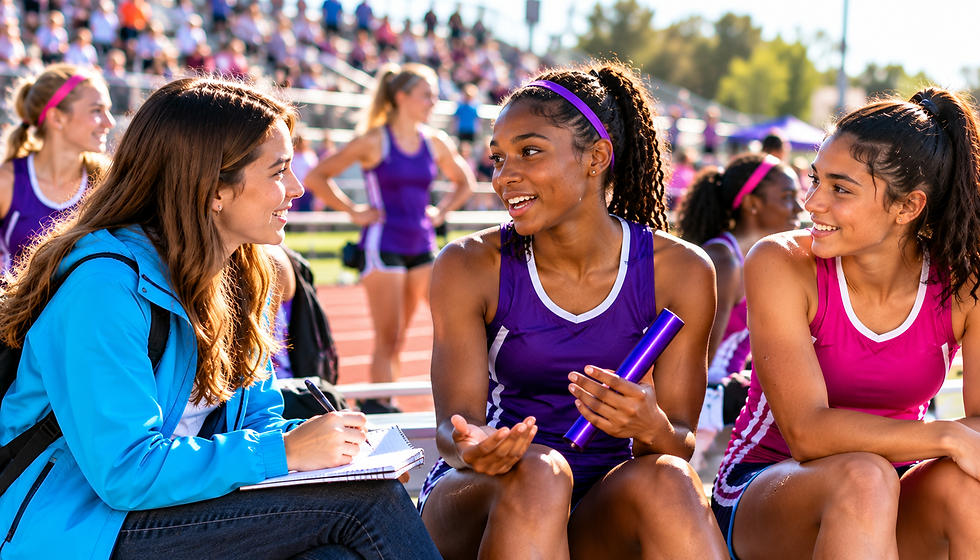
An athlete should be more than an illustration of what adults think girls’ sports represent. She may be proud of a win, frustrated by a mistake, excited about a new skill, or focused on a teammate’s contribution. Those reactions are not interchangeable. Reporters discover them by asking open questions and resisting the urge to supply the answer.
The most useful interviews often leave room for an unexpected response. “What do you wish people understood about your team?” can reveal a practice routine, a community tradition, or a challenge that would never appear in a game summary. A thoughtful follow-up—“Can you give me an example?”—turns a general statement into reporting that readers can understand.
An example of looking beyond competition results is our Coach Spotlight on Maginur Gilmutdinova, whose story explores how athletes develop confidence, responsibility, and teamwork beyond their placements.
How Student Sports Journalism Can Give Girls a Voice
School newspapers, student media programs, and classroom reporting projects can help expand the range of sports stories a community sees. Students already know the rhythms of their schools, but familiarity is only the starting point. Journalism teaches them to verify a name, seek another perspective, distinguish observation from opinion, and give someone the dignity of being represented accurately.
Picture a student reporter arriving at a girls’ team game that rarely appears in the local paper. She begins with a roster and a schedule, but the real story takes shape only when she starts asking questions. A goalkeeper may explain the save that changed the match. A coach may reveal the tactical decision behind a comeback. A family may describe how the team became part of its weekly rhythm. The reporter cannot know which story she will find before she arrives. Showing up, listening, and discovering what is true is the work.

This is the purpose behind Her Sport | Her Story, a storytelling initiative Women Sports USA® is developing for young interviewers and future storytellers. Rather than teaching students what conclusion to reach, the initiative helps them ask better questions, listen carefully, verify what they learn, and understand that every published story carries a responsibility to the people represented in it.
How to Report on Young Female Athletes Responsibly
Accuracy Is a Form of Respect
Check names, ages, schools, scores, positions, and quotes that need checking. A dramatic sentence is not worth publishing if the facts are uncertain. The Society of Professional Journalists’ ethics code emphasizes verification, fairness, transparency, and care for people affected by coverage. These principles matter in a national newsroom, and they matter just as much in a student feature about a local match.
A student journalist should know the difference between a recorded quote and a remembered impression. A coach’s explanation may add context, but it should not replace the athlete’s own account. When reporting includes criticism or a contested decision, fairness means checking the relevant facts and seeking an appropriate response rather than publishing the first version heard.
Give Young Sources Meaningful Choice
Reporting on minors requires additional care. Journalists should explain where a story may appear, follow applicable law and the permission policies of the school, league, or organization involved, and avoid pressuring young athletes to share private information. Guidance from the Journalism Education Association and other student-press resources emphasizes sensitivity to minors and a clear understanding of consent. For an independent nonprofit publication, documenting parent or guardian permission before identifying a minor provides an additional editorial safeguard.
An athlete may want to discuss her performance without discussing a personal hardship, and that boundary deserves respect. Reporters can make a meaningful choice by explaining the topic, letting the athlete decline a question, and checking whether she is comfortable continuing when the conversation moves into sensitive territory. A good interview is not a contest to extract the most emotional answer; it creates room for the athlete to contribute something true and meaningful on terms she understands.
Building Better Local Girls Sports Coverage That Lasts
A sustainable reporting practice can begin with a repeatable routine: cover a game, confirm the facts, interview an athlete and a coach, publish promptly, and return the next week. Over a season, rotate attention among teams, competition levels, and less-visible sports instead of appearing only when a title is at stake. Readers trust local coverage when it is accurate, consistent, and interested in the sport's full life—not only its most celebrated moments.
Local coverage can also connect today’s games with the history that made them possible. A school team exists within a larger story of access, facilities, coaches, officials, and earlier generations of athletes. A link to a women’s sports history timeline or a well-researched community feature can give readers that context without turning every game recap into a history lesson.
Meaningful sports reporting also examines the conditions surrounding competition, including the facilities and resources available to girls.
An athlete does not have to become famous for her story to matter. The value lies in the attention we give to what she has done, how accurately we describe it, and the possibility that another girl will read the story and recognize a place for herself.
Some of the most important stories begin before the first game, with the women who create sports programs where no opportunities previously existed.
The Next Headline Begins With a Better Question
We can keep the score and still look deeper. We can celebrate a championship while still covering the teams that are learning, rebuilding, and returning to practice after a difficult loss. We can honor athletic excellence without turning an athlete into a symbol. And we can invite young reporters into this work while teaching them that curiosity and accuracy belong in the same notebook. Better coverage does not ask us to choose between the game and the story. It asks us to pay close enough attention to see both.
The next meaningful girls’ sports story may be waiting in a school gym, on a neighborhood field, or beside a track after everyone else has gone home. Finding it starts with a practical commitment: choose a team that gets little consistent coverage, show up more than once, learn the sport, and ask questions that let athletes describe what happened in their own words. Better local storytelling starts when attention becomes a habit rather than a special occasion.
Frequently Asked Questions
What is girls’ sports coverage?
Girls’ sports coverage includes reporting on competitions, athletes, teams, coaches, and issues affecting girls’ participation. Strong coverage uses accurate results and context, not just inspirational language.
How can a school improve coverage of girls’ teams?
Start with a reliable schedule and results process, give reporters access through approved channels, cover a variety of sports, and include athletes’ perspectives while following consent and privacy rules.
Can students interview other students about sports?
Often, yes, subject to school rules, applicable law, and ethical safeguards. For an independent nonprofit publication, it's best practice to obtain clear permission and parent or guardian authorization before identifying a minor.
Stay Connected With Women Sports USA®
Explore more women’s sports stories, subscribe for new perspectives, nominate an athlete or coach whose work deserves thoughtful coverage, or partner with Women Sports USA® to help local stories reach more readers.
Dream. Believe. Achieve.
Keep the inspiration going.
Get women’s sports stories and interviews delivered to your inbox.
Whose story should we tell?
Help us recognize an athlete, coach, official, or trailblazer.
Help more stories reach the world.
Explore ways your organization can support our storytelling mission.

Linda Herron is the Founder and CEO of Women Sports USA®. She is a former Division I field hockey athlete and coach, an author, and a business finance executive with over 40 years of experience.


Comments