
The Team That Didn’t Exist Yet—How Women Build Girls’ Sports Programs

Every girls’ team begins before the first practice—with someone who sees what is missing, refuses to let “no team” be the final answer, and invites others to help build what comes next.
Written by Linda Herron
Women Sports USA®
“Where can I play?” a girl asks. “There isn’t a team,” she is told. No roster. No coach. No practice schedule. No place to compete. In a few words, a door begins to close before she ever has the chance to step through it. Unless someone decides that "no" can become "not yet," her interest might wane—and she might never realize what the sport, the team, and her own potential could have revealed.
That closing door is where this story begins. For the women who build girls’ sports programs, a missing team isn't just a problem to note; it is an invitation to act. They begin asking what it will take to create the missing opportunity: Who will coach? Where can the girls practice? What equipment will they need? Who else will help? The answers are rarely simple, but each one can bring another person into the effort—and move a team from possibility toward its first practice.
A program begins to take shape when one person pays attention. She sees that girls are missing an opportunity already available to others, or that the community has no place for an entire sport. She may be a former athlete, a parent, a coach, a school employee, or a neighbor who keeps hearing girls ask for a chance. She may not have a detailed plan or a budget. What she has is the conviction that “there isn’t a team” does not have to be the end of the story. Before she can build the program, however, she must understand the gap and listen to the girls whose experience should shape what comes next.
Building Girls’ Sports Programs Starts by Listening to Girls
Sometimes the gap is easy to see. A school may have teams for boys but none for girls in a particular sport. A town may offer recreation leagues, but only for activities that have traditionally attracted boys. In other places, a team may technically exist, while girls may receive limited practice time, outdated equipment, or little support. The program’s name may appear on a website, but girls and families may still face barriers that make participation difficult.
Program builders consider these barriers together because they often reinforce one another. Affordable fees do not create access if a girl cannot reach practice, and a nearby team offers little opportunity if equipment costs put participation out of reach. A place on the roster matters only when a girl can get there, afford to join, and feel that she belongs.
For a broader look at girls’ participation and the barriers they face, see the Women’s Sports Foundation’s WSF Sport Report 2026.
Listening is the first planning tool. If girls want to try a sport before committing to a full season, organizers can begin with a clinic or introductory program. If beginners need time to learn the basics, the program can create a welcoming entry point before competitive play. Families may need affordable fees, loaner equipment, transportation help, or a convenient practice location. Coaches may need training and support, while schools or community groups may have space but need someone to coordinate it. These responses help organizers build around the people the program is meant to serve instead of asking girls to fit a structure that was never designed with them in mind.

Project Play’s Children’s Bill of Rights in Sports offers a framework that includes safe environments, qualified program leaders, developmentally appropriate play, and a voice for young athletes in shaping their activities.
Listening also reveals what girls want from the experience. Some dream of competing at the highest level. Others want to play with friends, learn a skill, or find out whether the sport feels like theirs. A strong program does not force every girl into the same starting place. It creates room for ambition and curiosity, for experienced athletes and first-time players, and gives each girl a meaningful chance to belong.
Building a Place to Play
What organizers learn through listening becomes the blueprint for the program they build. The program needs a place to practice, a schedule families can manage, enough players to form a team, and someone willing to coach. Organizers must also secure equipment, communicate with parents, arrange registration, understand safety requirements, and find opportunities to compete. Much of this work happens in the hours organizers might otherwise spend on their jobs, families, or other responsibilities, which makes shared ownership essential from the start.
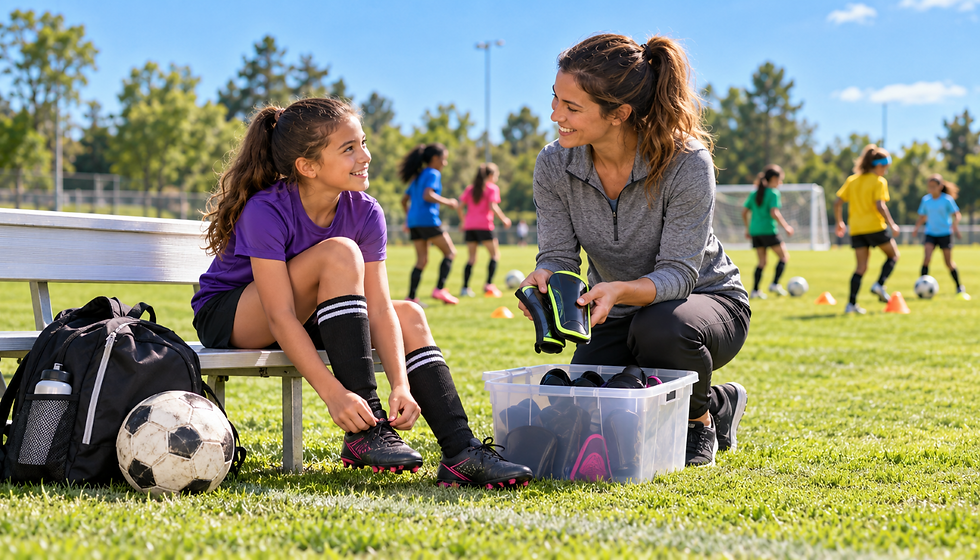
One person may take the first step, but a team takes shape when others step in beside her. A former athlete agrees to coach. A parent handles registration or organizes carpools. A school administrator finds an open hour in the gym. A community partner donates equipment or helps lower the cost. Someone else reaches the family that never imagined this sport was for their daughter. Piece by piece, one woman’s idea becomes a shared promise: this opportunity matters, and we will help make it real.

The work rarely moves in a straight line. A request for field time is delayed. There is not enough equipment. The first group of interested girls is too small to form a full team. Again and again, the organizer must explain why the opportunity matters, reopen a stalled conversation, or reshape the plan without shrinking the vision. Progress may look modest—a clinic, a short introductory season, a shared practice space—but each small step brings the team closer to becoming real.
As the plan takes shape, organizers must translate what they heard into practical decisions. Expensive gear can exclude girls before the first practice, while beginners need a way to learn without feeling embarrassed for not knowing the rules. Families also need clear information about schedules, costs, and transportation. Paying attention to these details turns a verbal welcome into genuine access and helps prevent avoidable obstacles from keeping girls out.
A program does not need every resource in place before it begins, but it does need an honest starting point. Organizers should be clear about what is available, what is still needed, and what must be resolved before girls arrive. That preparation may include confirming practice space, setting realistic fees, securing essential equipment, explaining registration, and identifying who will support the coach. Starting small can work when families understand the plan and organizers are ready to learn from the season that follows.
Learning from the First Season
When a new team finally takes the field, success may have little to do with a championship. It may mean having enough players to begin, a coach who returns for another practice, or a girl who arrives uncertain and leaves asking when she can come back. For some players, this is their first experience with organized sports—their first time learning the rules, relying on teammates, and discovering how competition feels. A program that gives them room to learn has already won something important.
Teams are built through everyday choices. A coach who learns each player’s name, welcomes questions, and treats mistakes as part of learning shows girls that development matters. Meaningful time to practice and compete tells players that they have a real place on the team. Teaching teammates to support one another when someone struggles turns belonging into a shared responsibility. Together, these choices shape whether girls grow in confidence and want to return for another season.

Different experience levels test whether that culture is real. One player may have competed for years; another may be holding a stick, ball, or racket for the first time. A thoughtful coach closes that distance by teaching fundamentals, setting clear expectations, and recognizing effort as well as results. As beginners see their improvement and experienced players learn to support others, the team becomes stronger. Each girl begins to understand that her growth matters and that she, too, has a meaningful role in helping others grow.
The first season gives organizers evidence they could not gather while planning. Families may reveal that registration instructions were unclear or that transportation information arrived too late. Coaches may identify the need for more equipment, another practice time, or additional support. These discoveries do not mean the program has failed; they show what must change to help girls keep playing. When organizers respond to what the season teaches them, a one-time opportunity can become a program that grows stronger each year.
Wins may come, and they deserve celebration, but a new program’s success is also measured by what girls begin to believe and do. It appears in the player who keeps showing up, develops a skill, or becomes comfortable speaking up. It appears in the teammate who encourages a beginner and the coach who recognizes potential before an athlete sees it in herself. Those changes may never appear on a scoreboard, yet they show that the program is creating confidence, connection, and a reason to return.
Recognizing the Women Behind the Team
The women who build girls’ sports programs are often most visible in the opportunity they create and least visible in the story of how it came together. Their names may never appear in a headline. By the time people see a team photo or hear that a new league has started, the calls, forms, planning, problem-solving, and late evenings behind it may already have disappeared from view. The team becomes public; the labor that made it possible often does not.
Their leadership is present in every part of the opportunity. It appears in the woman who agrees to coach, the organizer who keeps asking for practice space, and the community member who contributes equipment. Their work also makes it possible for parents to get players to practice and for teammates to welcome each new girl. Together, these contributions create more than a schedule. They create a place where girls can test their abilities, build relationships, and experience a team's shared purpose.
The impact can continue long after the first season. A girl who joins the team may become a lifelong athlete, or she may discover that she wants to coach, officiate, or organize a program herself. A parent who volunteers may become the person who notices the next gap in the community. A young player may grow up determined to make sure the next generation never has to ask whether a team exists. In this way, one program does more than create a season; it creates people who know how to build the next opportunity.
Not every girl will stay in the sport for years, but the opportunity can still shape what she carries forward. One season can help her discover what she enjoys, how she responds when something is difficult, and how much she can learn through practice. She can experience competition and cooperation, confidence and uncertainty, disappointment and progress. Whether she remains an athlete or chooses another path, she leaves knowing that she stepped into an unfamiliar space and grew there—and that is one more reason to create the next opportunity.
Creating What Comes Next
A lasting opportunity does not require a perfect beginning. It requires someone willing to recognize the need, invite others into the work, and keep going when practical challenges pile up. From there, the program grows through the commitments that sustain it: girls help shape the experience, families feel welcomed, coaches receive support, and the community treats girls’ participation as something worth planning for, investing in, and protecting.
The team that doesn't exist yet may be one conversation away from its first practice—and you can start that conversation. Contact the school. Speak with the recreation department. Gather interested families. Ask a coach to introduce the sport. The beginning may be modest—a clinic, a shared field, donated equipment, or a few girls learning together—but modest beginnings still need people willing to act. One person can open the door; a community can help keep it open.
Across communities, women are turning empty spaces into places where girls can arrive, learn, compete, and discover what they are capable of. Every program begins because someone notices who is missing, listens to girls asking for a chance, and stays long enough to make that chance real. The team may not exist yet. But when a girl steps onto the field, court, floor, or track and knows she belongs, imagination becomes opportunity—and the door that once began to close opens again.
Dream. Believe. Achieve.
Keep the inspiration going.
Get women’s sports stories and interviews delivered to your inbox.
Whose story should we tell?
Help us recognize an athlete, coach, official, or trailblazer.
Help more stories reach the world.
Explore ways your organization can support our storytelling mission.

Linda Herron is the Founder and CEO of Women Sports USA®. She is a former Division I field hockey athlete and coach, an author, and a business finance executive with over 40 years of experience.


Comments